
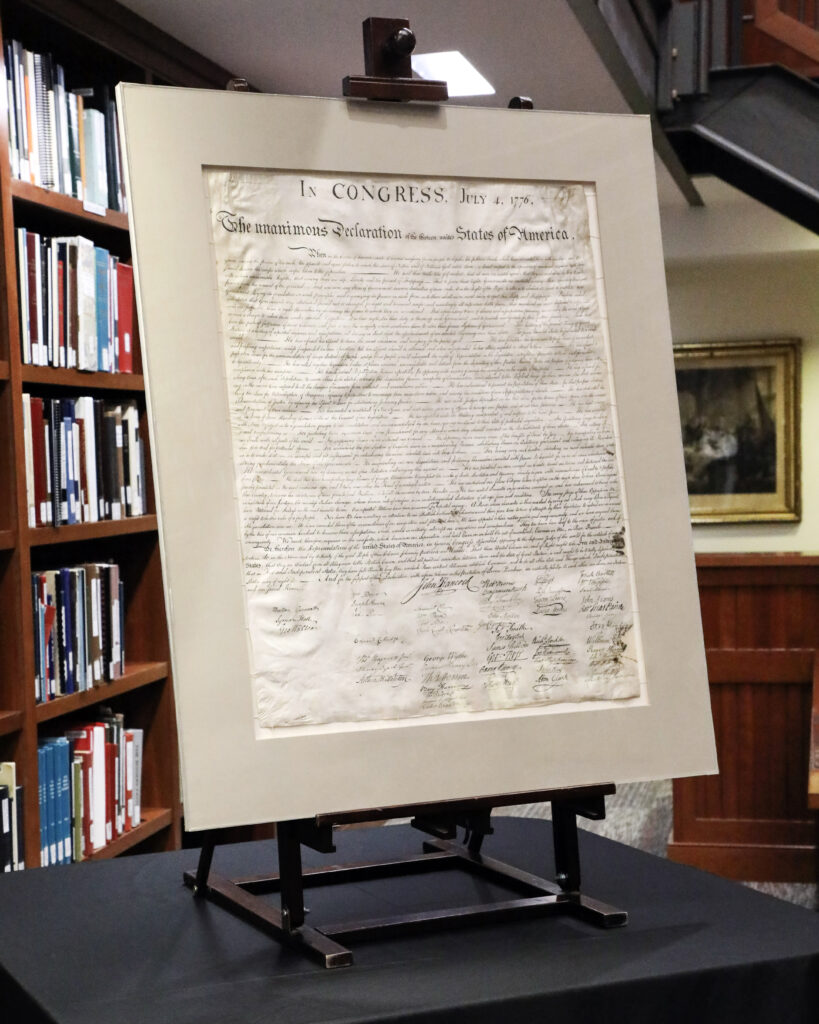
 THE 1823 WILLIAM STONE ENGRAVING OF
THE DECLARATION OF INDEPENDENCE
On view from Thursday, January 22, 2026
Through Saturday, September 5, 2026
Monday to Friday, 9:30 AM until 4:30 PM
LAST ENTRY AT 4:00 PM
Entry to view The Stone Engraving is FREE.
Entry DOES NOT include use of the SAR Genealogical Research Library.
Please click HERE for our visitor policies
*In cases of inclement weather, the library and headquarters follow the same schedule as the Jefferson County Public School System.
The Stone Engraving: America’s Icon of the Declaration of Independence
When Americans picture the Declaration of Independence, most envision a bold, elegant document filled with flowing script and crowned by the unmistakable signature of John Hancock. That familiar image, however, is not the original Declaration signed in 1776.
The original parchment Declaration—now preserved in the National Archives—is written in pale brown ink on off-white parchment. Time has greatly faded its text and signatures, making it difficult to read. The image that Americans know and recognize today comes instead from an engraving produced nearly fifty years later.
A Nation Looks Back
Following the War of 1812, a renewed sense of patriotism swept the United States. As the Revolutionary generation aged and passed on, Americans came to revere the Declaration as a sacred national symbol. This growing reverence created demand for an accurate, official reproduction of the document.
Two early publishers, John Binns and Benjamin Owen Tyler, competed to produce large printed versions of the Declaration. While their prints helped spread the text, neither fully captured the original document’s appearance.
William Stone’s Historic Engraving
In 1820, Secretary of State John Quincy Adams, son of Founding Father John Adams, commissioned Washington engraver William Stone to create a true facsimile of the Declaration—one that faithfully reproduced both the text and the signatures exactly as they appeared on the original parchment.
After three years of painstaking work, Stone completed the copperplate engraving in 1823. The State Department ordered 200 impressions, printed on parchment and nearly the same size as the original document. Congress later directed that these engravings be distributed to government offices, notable leaders, and the surviving signers of the Declaration, including Thomas Jefferson and John Adams.
An Enduring National Image
Stone’s engraving became the definitive image of the Declaration of Independence. It is the version reproduced in textbooks, displayed in schools and libraries, and recognized by generations of Americans.
Unlike earlier printings, Stone’s engraving closely mirrors the original document in layout, scale, and detail. Its authenticity and official status elevated it beyond a simple reproduction—it became a national icon.
Preserved for the Nation
Today, fewer than three dozen of the original parchment prints are known to survive. Stone’s original copperplate is preserved at the National Archives, a tangible link between the Founding Era and the early Republic.
The Stone engraving stands as a powerful reminder that while the words of the Declaration were written in 1776, each generation renews its commitment to the principles it proclaims—liberty, equality, and self-government.
A Joint Collaboration to display this Historic Document
The National Society of the Sons of the American Revolution (SAR), together with the Louisville-Jefferson County America250KY Committee is proud to be able to place on display one of the very few remaining engravings that is available for public view. It is the only one available to view in Kentucky. It was given to Louisville in 1986 by the family of William P. Mulloy. Its history is uncertain, but it might have been originally given to the state of Maine.
In 2010, the document underwent an ICA-Certified conservation process, and was subsequently placed in a high security, temperature and light-controlled environment at The University of Louisville. This is the first time in over 15 years that it has been made available for public view. Due to the light-sensitive and fragile nature of the document, it will only be on view at the SAR Genealogical Research Library through Labor Day, 2026.
__________________________________________________
Adapted from: Nicholson, C. (2003). The Stone engraving: Icon of the Declaration. Prologue Magazine, 35(3). National Archives and Records Administration.